Taipei Zoo Course Assistant LINE Bot
Rules for questions with one right answer, a language model for the rest, and a home-made blind-testing skill to find what visitors expect but the bot cannot answer
- My role
- Product definition, architecture calls, test-method design; built with Cursor and Claude Code
- Stack
- FlaskOpenAI GPTRAGFirestoreCloud Run
- AI collaboration
- Claude CodeCursorOpenAI GPT
- 6
- Development stages · From scaffold to memory and retrieval
- 2
- Blind-test personas · Wheelchair companion, field-trip teacher
- 35
- Blind-test questions · Two rounds against production, 2026-09-13
- 3
- Fixes from blind tests · Message cap, closure false positive, stuck ticket flow
01Problem
Taipei Zoo runs environmental-education activities every month: keeper talks, themed stations, scheduled courses. The information is spread across several pages on the zoo's website, and ticket prices, closures and transport live on other pages again. A visitor planning a day out with a child or an elderly parent has to piece together what is on that day, what the tickets cost and which exhibits are closed.
I wanted people to simply ask in LINE, in their own words. The real problem turned out not to be how to wire up GPT, but which questions the model should answer and which it must not. "What is on Saturday" and "how much is a student ticket" have one right answer, and a single wrong reply destroys trust. "How do we visit without tiring grandma out" has no single answer, and that is where a language model earns its place.
02Users & Context
The primary users are ordinary visitors: parents, teachers, family members accompanying older relatives, all asking through a LINE official account. They do not know how the website is structured, they phrase things casually, and they often spread one request over several messages ("three of us need tickets", "one is a Taipei resident", "and a student").
The second user is me. The bot doubles as a portfolio piece that strangers can try, so it has to survive abuse without running up the bill, and it has to keep its timetable current while nobody is watching.
03Constraints
- No labelled data. The original plan had a home-trained BERT for interest classification, but there were no real conversations to label, so any F1 score would have been a projection.
- Cost. Every GPT and embedding call costs money. Off-topic questions should cost nothing, and neither should questions with a deterministic answer.
- Data goes stale. The timetable changes monthly and the open-data format drifts a little each month; manual upkeep once lapsed for half a year without anyone noticing.
- One person operating it. One Cloud Run service and one Firestore database; no room for a vector database or a PostgreSQL instance to look after.
- Public exposure. Strangers can try it, so there is a per-user message cap, and every external dependency must fail open rather than turn into a 500 on the webhook.
04Approach & Trade-offs
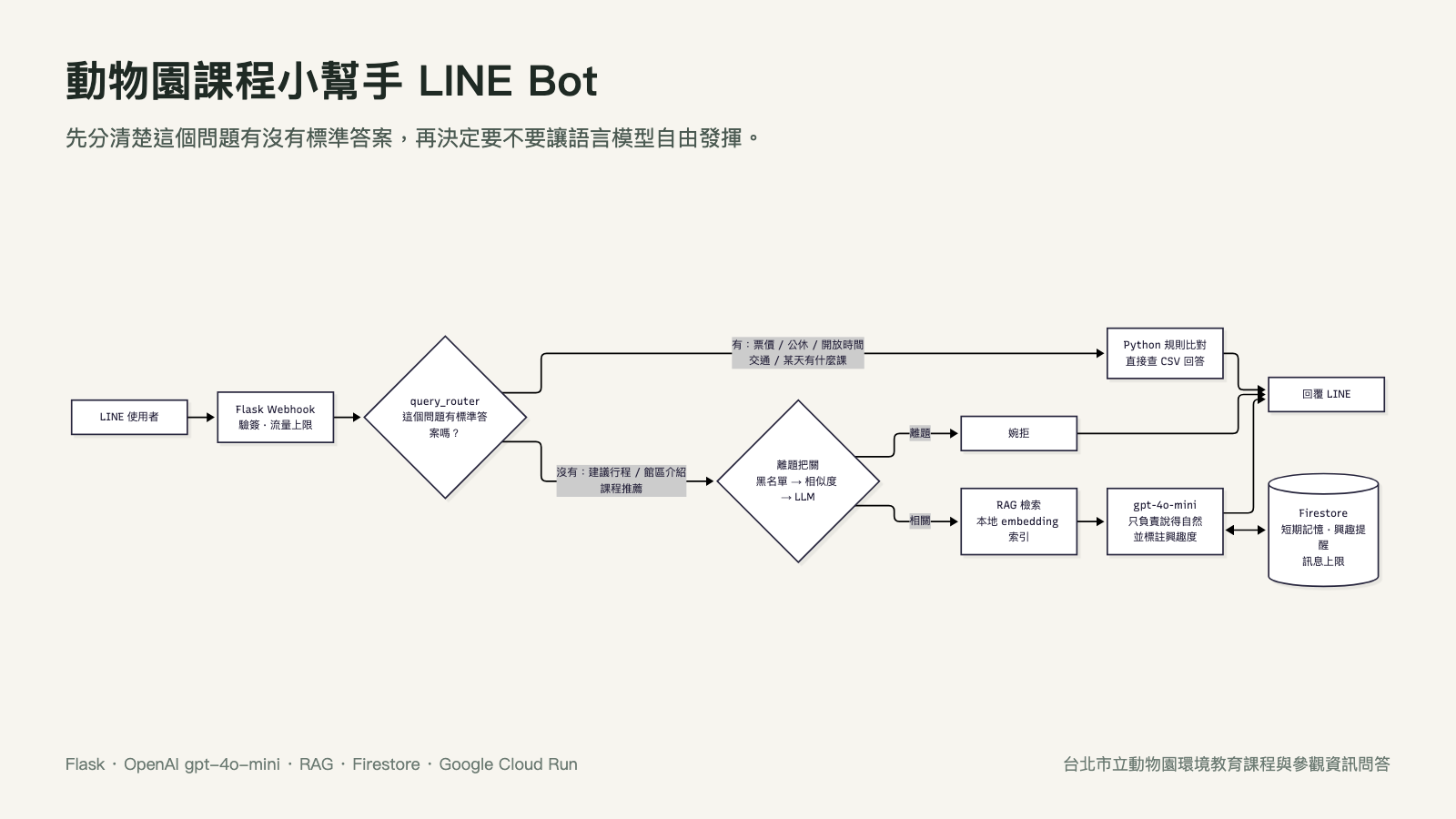
One rule drives the architecture: decide whether the question has a single correct answer before deciding whether to let the language model improvise.
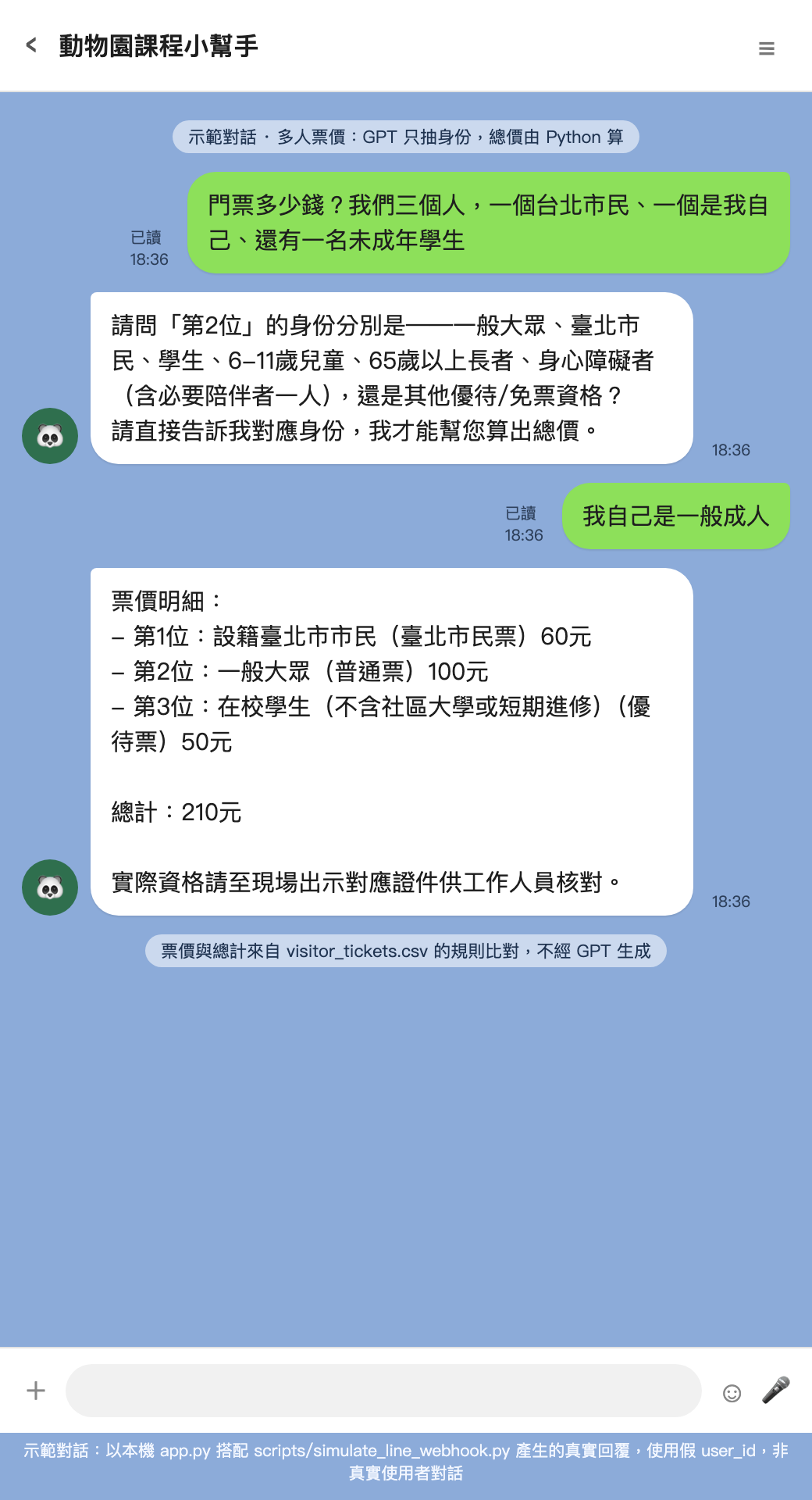
- Deterministic questions (tickets, hours, closures, transport, what is on a given day) are structured into CSVs and answered by Python rule matching; GPT never touches the content. Group ticket quotes follow the same split: GPT only extracts who is what, Python does the arithmetic.
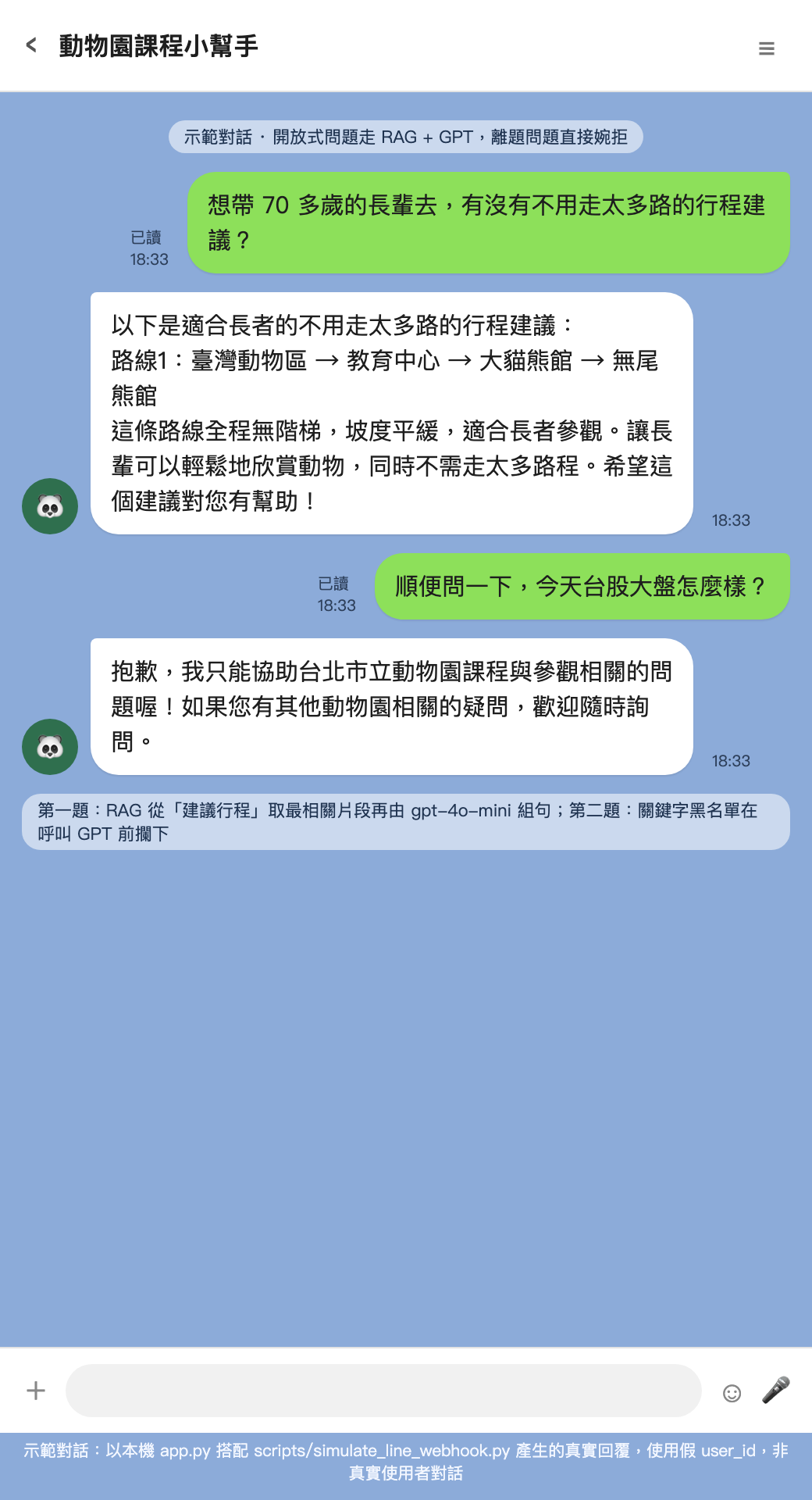
- Open-ended questions (itineraries, exhibit descriptions, course suggestions) go through cosine retrieval over a local embedding index first, then gpt-4o-mini phrases the answer and tags the interest level. No whole-section dumping, no external vector database.
- Off-topic questions (stocks, code, maths) meet a three-layer guard, cheapest first: a keyword blacklist, a similarity threshold against the index, and a lightweight LLM check with conversation history only for the grey zone. Thresholds were calibrated on real production questions.
- Memory and reminders live in Firestore: five rounds and seven minutes of short-term memory, one reminder per interest event, everything wrapped to fail open.
- Dropped: the home-trained BERT (no data), APScheduler push notifications (replaced by a reminder appended to the next reply), PostgreSQL (containers have no persistent disk).
Key decisions
05How I Worked with AI
Two AI collaborators worked on this project: Cursor for the February 2026 scaffold and environment fixes, Claude Code for the RAG, Firestore, blind-testing and operations work from September on. My job stayed the same: decide who a given problem belongs to, then turn that call into a requirement that can be checked.
The clearest example is that I turned the test method itself into a Claude Code skill. Hand-written test cases favour questions I already know the bot can answer, so they never find the gap between what a visitor expects and what the bot can do. The skill requires that I supply only a persona (a relative pushing a wheelchair, a teacher planning a field trip); a sub-agent that has never seen the data folder does the asking, writes every question before asking any, and classifies only after the last reply. Replies come back from Cloud Logging in four classes: answered well, expected an answer but got none, half an answer, correctly declined.
Two rounds and 35 questions surfaced three problems no pre-designed test would have caught: a five-message cap that stopped the service at question six, the word for "rest" read as a closure query, and a group-ticket flow that would not let go. The other key collaborations followed the same pattern: I brought an observation (a failing build log, a 21-hour crash loop, a timetable three weeks stale) and a requirement; the AI found the root cause and implemented the fix, with the reasoning kept in the code's docstrings.
Human–AI moments
Environment landmines: runs locally does not mean it builds
What I decided
The app ran fine locally but Cloud Build failed. I pasted the failing section of the build log and asked the assistant to first establish exactly which packages were in conflict, rather than rebuilding the whole environment.
What AI did
Cursor pinned down the hard conflict between numpy==1.24.0 and seaborn and relaxed it to a range (>=1.22.4,!=1.24.0,<2); for the aenum compile error caused by leftover Python 2 syntax it added --no-compile to pip in the Dockerfile.
Outcome
Cloud Build passed and the bot went live on Cloud Run for the first time. The same aenum trap resurfaced in setup.sh four months later and got the same --no-compile fix.
Lesson Use version ranges, not pins; read the error before touching the environment
The turning point: taking judgement back from GPT
What I decided
I noticed that for a verifiable question like 'what is on Saturday' GPT would pick the wrong weekday or drop courses, and two days of commits had gone into arguing with it in the prompt. I stopped patching the prompt and asked for Python to filter courses by weekday first, leaving GPT only to phrase the result.
What AI did
The assistant (Cursor) added detect_query_weekday and matches_weekday for weekday matching and pre-filtering, then fallbacks for when filtering fails, and went on to structure tickets, closures and hours into CSVs behind a single query_router.
Outcome
Deterministic queries no longer pass through GPT's judgement. The principle later spread across the project, including group ticket quotes (GPT only extracts identities, Python sums) and returning the environmental-education hours text verbatim.
Lesson Questions with one right answer should never be left to a free-form model
A 21-hour worker crash loop in production
What I decided
After the per-user message cap shipped, Cloud Run logs filled with gunicorn WORKER TIMEOUT and SIGKILL entries, starting exactly at that deploy. I handed Claude Code the logs and the timeline and asked for the link to the change, not just a bigger timeout.
What AI did
Claude Code found that rate_limiter, interest_store and conversation_memory each created their own Firestore client, up to three initialisations per message; it introduced a shared per-process singleton and widened the gunicorn timeout from 30 to 60 seconds as a safety net.
Outcome
The crash loop stopped. The reasoning lives in the firestore_client.py docstring so whoever comes next can see why.
Lesson Find the root cause tied to the change first, then add the safety net
A home-made blind-testing skill: let an agent that does not know the answers ask
What I decided
Hand-written test cases inevitably favour questions I already know the bot can answer. I designed a Claude Code skill: I supply the persona (a relative pushing a wheelchair, a teacher planning a field trip), a sub-agent that has never seen the data folder does the asking, and it must write all its questions before asking any and classify only after the last answer.
What AI did
Claude Code ran two rounds, 35 questions in all, against production from an isolated sub-agent, pulled the full replies back from Cloud Logging and sorted them into four classes. The main agent logged each persona verbatim and, after the second round exposed a 'only the first log line was fetched' flaw, wrote the correct two-step retrieval back into the skill.
Outcome
Round one hit the permanent five-message cap at question six, raised to twenty the same day. Round two surfaced 'rest' being misread as a closure query and a group-ticket flow that would not let go, both fixed the next day. None of the three would have been caught by pre-designed test cases.
Lesson Whoever asks must not know the answers; turn the test method itself into a reusable tool
A liveness check after the pipeline failed silently for three weeks
What I decided
The daily timetable pipeline was built to skip safely and retry tomorrow. After mid-September it skipped four runs in a row, and only in early October did I notice production had been answering from a stale timetable for three weeks. I asked for an alert, but not a 'no update in seven days' rule that would cry wolf every month.
What AI did
Claude Code wrote check_pipeline_liveness.py: the signal is whether the month in courses_meta.json lags the current month, with a grace window on days 1 to 7 to separate normal waiting from a real failure. It always exits 0, reporting rather than blocking, so it cannot become one more silent gate. It also added an authentication pre-check before each scheduled run.
Outcome
Every scheduled run now starts with the liveness check and writes its result as the first line of the report. Skipping is fine; skipping without anyone knowing is not.
Lesson A fail-safe that skips safely but silently is only half built
06Outcomes
- The bot is live on Google Cloud Run, deployed automatically from main by Cloud Build, and reachable through a LINE official account.
- Six development stages and two architecture-level turns (rules first, then RAG plus memory), all traceable to commits and a written retrospective.
- Ticket, closure, opening-hour and course-date queries no longer pass through GPT's judgement; off-topic questions are stopped before GPT is called.
- The timetable rebuilds itself daily from the zoo's open data, with a quality re-check and a liveness check, so a silently stalled pipeline is now visible.
- The home-made blind-testing skill ran 2 personas and 35 questions and led directly to 3 fixes; a RAG golden test set and a locust load test each caught a class of problem that sequential testing could not.
There is no accuracy or F1 figure for this project. What there is: a reason for every decision, a source for every fix, and a repeatable test method whose rule is that the person asking must not know the answers.
Screens
07What I'd Do Differently
In hindsight the two architecture turns were the same sentence, but I only articulated it clearly the second time. Starting over, I would sort the data into "has a right answer" and "does not" on day one and design the architecture from that split, instead of handing everything to GPT and clawing it back one failure at a time.
Second, a fail-safe has to be finished. The timetable pipeline was built to skip safely on error, but nobody would know it had been skipping for weeks, so the silent failure merely shrank from six months to three weeks. Failing safely and making the failure visible are two separate jobs, and both have to be done.
Third, blind testing should have started earlier. The problems it found (a cap set too low, a keyword false positive, a stuck flow) were easy to fix; the hard part was having someone who did not know the answers ask before there were real users. Now that the tool exists, it belongs after every major change, not as an afterthought long after launch.